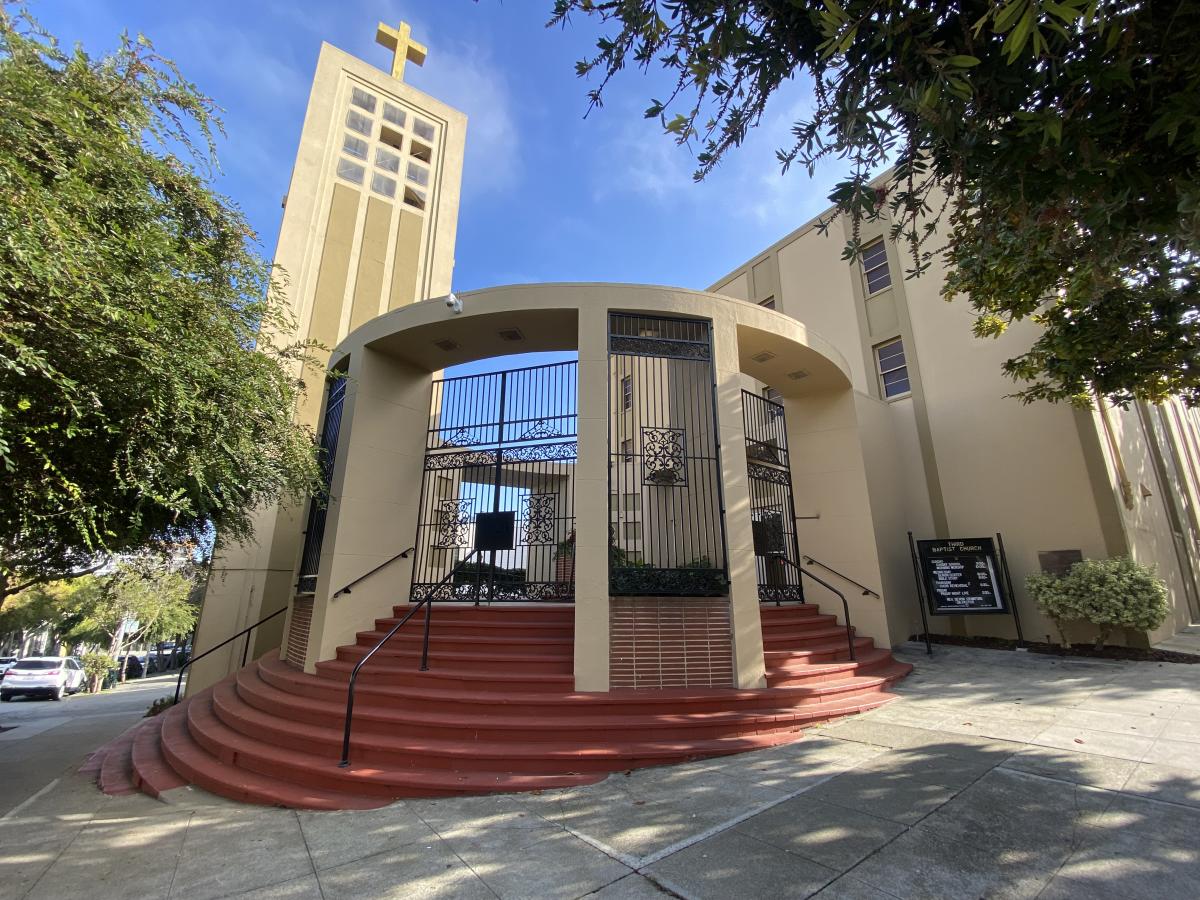
If you live or work near Alamo Square, or if you’re just passing by, you’ve almost certainly noticed the distinctive church with the tall bell tower at the corner of McAllister and Pierce Streets. That building is Third Baptist Church, one of San Francisco’s most important religious and civic landmarks, and a place whose influence reaches far beyond the neighborhood.
From Gold Rush San Francisco to the American West
Third Baptist Church was founded in 1852, during the Gold Rush, originally as the First Colored Baptist Church of San Francisco. It was the first African American Baptist congregation west of the Rocky Mountains, formed at a time when California was newly a state and African Americans across the country were fighting for basic rights in a nation still defined by slavery and exclusion.
From its earliest days, the church was more than a place of worship. Like many Black churches in the 19th century, it functioned as a civic anchor, a place where people could gather safely, organize, share information, and build leadership in a society that offered few protections. This made Third Baptist not just a San Francisco institution, but part of a broader American story of Black self-determination and democratic participation.
A new home in the Western Addition
As San Francisco grew and changed, so did the church. After earlier buildings were lost to fire and earthquake, Third Baptist eventually moved to the Western Addition, where much of the city’s African American population lived by the mid-20th century. In 1952–1956, the congregation built its current home at 1399 McAllister Street, including the sanctuary, a youth and fellowship building, and the now-familiar bell tower.
The architecture was intentionally modern. Designed in the Midcentury Modern style, the complex uses clean lines, simple geometric forms, textured glass, and light-filled spaces rather than traditional Gothic church imagery. This reflected Protestant ideals of clarity and directness, and it placed Third Baptist at the forefront of a new architectural approach later adopted by other African American churches in San Francisco.
Leadership that shaped city and nation
The church’s national significance is inseparable from the leadership of Frederick Douglas Haynes Sr., who served as pastor from 1932 to 1971. Under his nearly 40-year tenure, Third Baptist grew dramatically in size and influence, becoming a major center for civil rights organizing on the West Coast.
At a time when many histories of the civil rights movement focus on the American South, Third Baptist shows how deeply that struggle also unfolded in cities like San Francisco. The church hosted and supported nationally significant figures, including Dr. Martin Luther King Jr., W.E.B. Du Bois, Paul Robeson, and Josephine Baker, linking local campaigns for fairness and dignity to nationwide movements for voting rights, fair employment, and educational equality.
Rev. Haynes himself made history in 1945 as the first African American to run for the San Francisco Board of Supervisors. Although he did not win, his campaigns helped establish African Americans as a political force in the city and reflected a broader national shift toward Black political participation in the decades leading up to the Civil Rights Act and Voting Rights Act.
Community strength through change
During the era of urban renewal, when large parts of the Western Addition were demolished and thousands of residents displaced, Third Baptist played an active role in advocating for community voice, affordable housing, and social services. The church partnered with other organizations to push back against purely top-down redevelopment and to insist that longtime residents be part of shaping the neighborhood’s future.
This work reinforced a long tradition: Third Baptist as both a spiritual home and a platform for civic action, rooted in the belief that faith and justice are inseparable.
A living landmark
In 2017, the City of San Francisco formally recognized this history by designating the Third Baptist Church complex San Francisco Landmark No. 275. Today, the church remains an active congregation and a visible reminder that national movements are often built quietly, over generations, in neighborhood institutions like this one.
For the Alamo Square neighborhood, Third Baptist Church is not only an architectural landmark, but a living link between local community life and the broader history of American democracy and civil rights.